Best Hoop Earrings for Every Face Shape: A Stylist's Honest Guide (2026)
HyraModeThe wrong hoop earrings can make your face look wider, shorter, or unbalanced. The right ones sharpen your jawline, elongate your neck, and frame your features like a good haircut does. The difference comes down to one thing: whether the earring's shape contrasts or repeats your face's natural geometry.
The One Principle Behind Every Recommendation in This Guide
Professional stylists use a concept called line direction when choosing earrings for clients. It works like this:
- Vertical lines elongate. An earring that's taller than it is wide makes the face appear longer and slimmer.
- Horizontal lines widen. An earring that extends outward adds visual width to the face.
- Curved lines soften. Round shapes near the jaw reduce the visual sharpness of angular bone structure.
The goal is always contrast, not repetition. Round face? Add vertical lines. Angular face? Add curves. Long face? Add width. Celebrity stylist Karla Welch explained this to Who What Wear: "Earrings should do what contouring does — create the illusion of symmetry." Every recommendation below follows this single principle.
How to Determine Your Face Shape
Pull your hair back, look in a mirror, and compare three measurements: forehead width, cheekbone width, and jawline width. Then compare your face's overall length to its width.
- Round: Width ≈ length. Soft edges, no angular jaw. Full cheeks.
- Oval: Length slightly > width. Chin and forehead gently narrow. The most balanced shape.
- Square: Width ≈ length. Strong, angular jawline. Broad forehead.
- Heart: Forehead widest. Cheekbones prominent. Chin tapers to a narrow point.
- Oblong: Length noticeably > width. Forehead, cheeks, and jaw roughly same width.
For a measurement-based method, Real Simple's guide walks through it with a ruler and three reference points.
Round Face: Why Elongated Hoops Work
A round face has roughly equal width and height with continuous soft curves — no sharp angles at the jaw or cheekbones. The visual problem: there's no vertical axis for the eye to follow, so the face reads as "wide."
Why elongated hoops fix this: An oval or teardrop-shaped hoop introduces a strong vertical line alongside the face. This gives the eye a top-to-bottom path to travel, creating the perception of length that the face shape doesn't naturally provide. It's the same optical principle behind vertical stripes on clothing — they don't physically change your body, but they redirect where the viewer's eye moves.
What to avoid: Perfectly circular hoops. They echo the face's roundness and reinforce the width. Also avoid very wide hoops — they add horizontal emphasis where you need vertical.
What works: Ovals, teardrops, elongated shapes. Ideally the hoop should be about 1.3-1.5x taller than it is wide. The Aura Oval Hoop Earrings hit this ratio naturally — the oval pulls the eye downward past the jawline without looking dramatically stretched.
Celebrity example: Selena Gomez and Chrissy Teigen consistently choose elongated earring shapes on red carpets. Compare their round-face photos with circular hoops vs. oval hoops — the difference in how "slim" their face appears is striking.
Oval Face: Why Almost Everything Works
Oval faces are slightly longer than wide, with a chin that narrows gently and a forehead that's slightly broader than the jaw. This is the most proportionally balanced face shape — the vertical and horizontal dimensions don't fight each other.
Why you have the most freedom: Since there's no dominant proportion to correct, earrings don't need to "fix" anything. Every hoop shape — round, oval, square, heart — will look proportional because the face itself provides the balance. Your choice is about personal expression rather than optical correction.
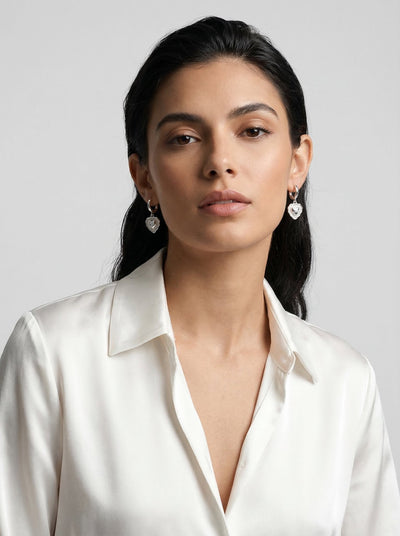
What to do with that freedom: Choose hoops based on the mood you want — playful (heart shapes), classic (simple rounds), edgy (geometric), romantic (floral drops). The Amor Heart Hoop Earrings are a great example — the heart shape adds personality that would compete with a less balanced face, but on an oval face, it's all upside.
Square Face: Why Curved Hoops Soften Your Look
Square faces have strong horizontal lines — a broad forehead, prominent jawline, and cheekbone width that's roughly equal to both. The visual characteristic: sharp 90-degree angles at the jaw corners create "hard" edges that dominate the face.
Why curved hoops work: When round or curved shapes sit near the jawline, the brain visually blends the earring's curves into the face's silhouette. The jaw doesn't physically change, but the overall impression softens because the eye now processes curves alongside the angles. This is the same principle makeup artists use when applying blush in circular motions on square faces — introducing curves near the hard lines.
What to avoid: Square, rectangular, or angular hoops. They mirror the jaw's geometry and double down on the sharpness. Geometric huggies are fine for a "lean into it" look, but if your goal is softening, stick with round.
What works: Round hoops, layered curved hoops, and wide C-shapes. Multiple concentric curves are especially effective — the Tria Triple Hoop Huggie Earrings create three layers of curved lines near the jaw, which multiplies the softening effect.
Celebrity example: Angelina Jolie's stylists almost exclusively pair her square jaw with round or curved earrings. Margot Robbie does the same — notice she rarely wears geometric earrings on red carpets.
Heart Face: Why Mid-Width Hoops Balance the Taper
Heart-shaped faces are widest at the forehead and cheekbones, then taper sharply to a narrow chin. The visual imbalance: the upper face carries too much weight relative to the lower face, making the chin look pointed or fragile.
Why mid-width hoops work: A hoop with substantial width (not huge, not tiny) adds volume at jaw level — exactly where the face narrows most. This redistributes visual weight downward, counteracting the top-heavy effect. Think of it as ballast: the earring adds "mass" to the narrow part of the face, evening out the overall silhouette.
The size sweet spot: Medium to slightly above medium. Tiny studs don't add enough visual weight to make a difference. Very large hoops actually draw attention upward to the cheekbones (where they sit), making the top-heavy problem worse.
What works: Chunky medium hoops that sit at or just below the jaw. The Bora Chunky Square Hoop Earrings add width exactly where heart faces need it — the slightly geometric shape introduces structure where the face naturally lacks it.
Oblong Face: Why Wide Hoops Shorten the Silhouette
Oblong faces are noticeably longer than wide, with a straight cheek line and similar width at forehead, cheeks, and jaw. The visual problem: the eye travels in a long vertical path from forehead to chin with nothing to interrupt it, making the face look elongated.
Why wide hoops work: Anything that creates horizontal spread at ear level interrupts that vertical eye path. The viewer's gaze hits the earring and moves sideways instead of continuing downward — this shortens the perceived face length. It's why oblong faces also benefit from side-swept bangs and wide-collar tops: horizontal lines at face level create visual width.
What to avoid: Long, narrow dangly earrings. They extend the vertical line you're trying to break. Even a large hoop isn't enough if it's a narrow wire — you need actual horizontal mass, not just length.
What works: Wide hoops, hoops with outward-projecting charms or details, and shorter-drop styles. The Sol Floral Charm Drop Angle Hoop Earrings are ideal — the floral charm projects horizontally from the hoop, and the angled design forces the eye sideways rather than downward.
How Hoop Size Interacts with Face Proportions
Size reinforces or weakens the optical effect of shape. A well-shaped hoop in the wrong size won't deliver the full benefit. According to Byrdie's jewelry editors, medium hoops (25-40mm) are the most universally effective size because they're large enough to create visible line direction without overwhelming the face.
- Small (12-20mm): Minimal visual impact on proportions. Best for everyday subtlety and sleeping in.
- Medium (25-40mm): The optimal range for face-shape flattery. Large enough that the eye registers the shape's line direction.
- Large (45mm+): Maximum effect but requires confidence. On very petite faces, can overwhelm — cap at 40mm.
Guideline: If you're between sizes, go one size up. Slightly too small looks accidental; slightly too large looks intentional.
How Hoop Thickness Changes the Effect
Thickness determines whether a hoop reads as "delicate" or "architectural."
- Thin wire (1-2mm): Creates subtle line direction. Best for stacking multiple earrings and for faces where you want a gentle rather than dramatic correction.
- Medium (3-4mm): Visible from conversation distance. Strong enough line direction for face-shape purposes while still being versatile.
- Chunky (5mm+): Architectural presence. The hoop itself becomes a visual element that the eye processes alongside your facial features — powerful for face shaping but best worn alone (no stacking).
Common Mistakes When Choosing Hoops for Your Face Shape
These are the errors stylists see most often:
- Round face + circular hoops: The most common mismatch. The hoop reinforces the face's roundness instead of contrasting it. Switch to ovals.
- Square face + geometric hoops: Doubling down on angles when the face already has strong ones. Unless you deliberately want maximum edge, choose curves.
- Oblong face + long dangles: Extends the vertical line instead of breaking it. Choose wide, not long.
- Heart face + tiny studs: Doesn't add enough visual weight below the cheekbones. The taper goes uncorrected. Go medium or larger.
- Choosing based on trend instead of proportion: A trending hoop style that doesn't suit your face will never look as good as a less trendy style that does. Proportion always beats trend.
Gold vs. Silver: Quick Skin Tone Match
Check the veins on your inner wrist in natural light:
- Greenish veins → Warm undertone → Gold hoops
- Blue-purple veins → Cool undertone → Silver hoops
- Can't tell → Neutral → Either works
Every hoop style at HyraMode comes in both gold and silver finishes.
Care Tips to Keep Your Hoops Looking New
Four 30-second habits:
- Store separately — hoop-on-hoop scratching is the #1 cause of surface wear
- Earrings on last — after perfume, hairspray, and lotion dry
- Wipe after wearing — soft cloth removes oils in five seconds
- Shower OK, pool no — PVD handles water, not chlorine
Full guide: How to care for gold and PVD jewelry →
Frequently Asked Questions
What hoop earrings suit a round face?
Elongated or oval-shaped hoops that introduce a vertical line alongside the face. The vertical axis redirects the viewer's eye downward, creating the perception of a slimmer, longer face. Avoid perfectly circular hoops — they reinforce the roundness.
Are hoop earrings still in style in 2026?
Yes. Hoops have been a top-3 earring category for over a decade. Pinterest's 2026 trend data shows "gold hoop earrings" searches up 28% year over year, with chunky hoops and layered stacks trending strongest.
Can you sleep in hoop earrings?
Huggie-style hoops (12-15mm) that sit flush against the ear — yes. Larger hoops with open closures should be removed before sleeping. They can catch on pillows, bend, and irritate the piercing.
What size hoop is most flattering?
Medium (25-40mm) for most faces. This size is large enough for the eye to register the hoop's shape and line direction, but small enough to wear in any setting. Go toward 25mm for petite faces, 40mm+ for oblong faces that benefit from added width.
How do I stop gold hoops from tarnishing?
Wipe after each wear, store in a pouch, apply beauty products before putting earrings on. PVD-coated hoops resist tarnishing significantly better than traditional electroplating because the coating bonds at a molecular level rather than sitting on top of the metal.
What face shape looks good in any hoop?
Oval. The naturally balanced proportions mean oval faces don't need optical correction from earrings — so any shape, size, or thickness works. Choose based on mood and personal style rather than proportion rules.
What's the difference between hoops and huggies?
Huggies are small hoops (12-15mm) designed to hug the earlobe closely. Traditional hoops hang further from the ear and range from 20mm to 60mm+. Huggies are your everyday, sleep-in-them default. Hoops are what you swap to when you want your ears to be noticed.
Do big hoops work in professional settings?
Medium hoops (25-35mm) are widely accepted. Larger hoops (45mm+) depend on your specific workplace, but the perception has shifted considerably — they're common even in corporate offices. When in doubt, medium is always safe.


