










How to Stack Bracelets Like a Stylist: The Complete 2026 Guide
HyraModeA single bracelet is a detail. A well-stacked wrist is a statement.
Bracelet stacking is one of the most visible jewelry styling techniques in 2026 — and one of the most misunderstood. Too often, people either pile on random bracelets and hope for the best, or they avoid stacking entirely because they are afraid of it looking messy.
The truth is that great bracelet stacking follows the same principles as any good styling: balance, variation, and intentionality. When you stack with purpose, the result looks curated and expensive. When you stack randomly, it looks cluttered.
This guide teaches you the rules, formulas, and product combinations that make bracelet stacking feel effortless in 2026.

The 3 Rules of Bracelet Stacking
Rule 1: Vary the Width
The fastest way to make a stack look intentional is to mix different widths. A slim chain next to a wide flat chain next to a medium beaded bracelet creates visual rhythm. If every bracelet is the same width, the stack looks monotonous.
Rule 2: Vary the Texture
Smooth metal, flat herringbone, beaded stone, twisted rope, paperclip links — each texture catches light differently. Mixing textures creates dimensionality. A stack of five identical smooth chains is boring. A stack of three different textures is interesting.
Rule 3: Anchor with One Hero Piece
Every great stack has one piece that is slightly bolder than the rest. This is the anchor — the bracelet that defines the mood of the whole wrist. The other pieces support it.

The 5 Best Stacking Formulas
Formula 1: The Classic Three
One wide + one medium + one slim. The simplest and most reliable formula.
Try: Hana Herringbone (wide) + Nilo Star Charm (medium) + Arlo Slim Box Chain (slim).
Formula 2: The Texture Mix
One flat chain + one beaded + one charm. This creates the most visual variety in the fewest pieces.
Try: Tali Flat Box Chain + Kova Lava Stone + Evia Charm Bracelet.
Formula 3: The Sparkle Stack
One CZ station bracelet + one flat chain + one delicate charm. For when you want more shine.
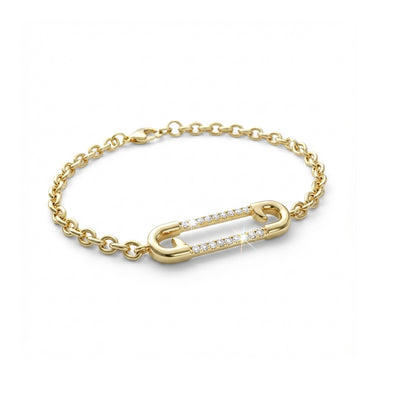
Try: Dalis CZ Station + Hana Herringbone + Luna Safety Pin Chain.
Formula 4: The Mixed Metal
Two gold + one silver, or two silver + one gold. The "unmatched" metal creates a modern, intentional look.
Try: Gold Hana + Gold Nilo + Silver Arlo.
Formula 5: The Minimalist Duo
Just two bracelets — one with width, one with detail. For women who want stacking without volume.
Try: Tali + Mavi Butterfly.

How Many Bracelets Is Too Many?
There is no universal limit, but there are practical ones:
- 2-3 bracelets: curated and clean — best for work, interviews, and minimal outfits
- 3-5 bracelets: the "arm candy" sweet spot — works for casual, weekend, and evening
- 5+: maximalist territory — only works if the textures and widths are intentionally varied
The rule of thumb: if the stack starts making noise when you move your hand, you have probably hit the limit.
Which Wrist Should You Stack On?
Most people stack on their non-dominant wrist because it faces less daily friction (typing, writing, mouse-clicking). That said, there are no rules — some people stack on both wrists, and some stack only on the hand that faces outward when they are holding a coffee or a phone.
If you wear a watch, stack on the opposite wrist. Watch + bracelet stack on the same wrist can work but requires careful sizing to avoid scratching.

Gold Stack vs Silver Stack vs Mixed
All gold: warmer, richer, more classic. Feels luxurious and cohesive.
All silver: cooler, sharper, more modern. Feels sleek and editorial.
Mixed metals: fashion-forward and intentional. The key is to let one metal dominate (2:1 or 3:1 ratio) rather than splitting 50/50.
In 2026, mixed metal stacking is fully mainstream. The "rule" that you cannot mix gold and silver is officially dead.
How to Stack Without Tangling
The biggest practical complaint about bracelet stacking is tangling. Here is how to prevent it:
- Use different chain types: a flat chain next to a box chain will not interlock the way two identical cable chains will
- Include at least one rigid piece: a cuff or wide flat chain acts as a "separator" between more delicate chains
- Avoid very thin, identical chains next to each other: they hook together instantly
- Store stacked bracelets flat and separated (see our Jewelry Storage Guide)
Stacking for Different Occasions
Work: 2 bracelets max. One flat chain + one slim chain. Quiet and polished.
Weekend: 3-4 bracelets. Mix textures, add a charm or symbol. More personality.
Evening: 2-3 bracelets with shine. CZ station + herringbone works beautifully in candlelight.
Vacation: 3-5 easy pieces. Waterproof PVD pieces only. Shell charms, butterflies, and relaxed layering.

Why Flat Chains Are the Secret Weapon of Stacking
Flat chains — herringbone, box chain, flat link — are the most important pieces in any stack. They provide a wide, reflective surface that anchors the other bracelets. They also prevent tangling because their flat profile does not hook onto adjacent chains.
If you are building your first stack, start with one flat chain and add from there. The Hana Herringbone and the Tali Wide Flat Box Chain are both ideal anchor pieces.
How Bracelet Stacking Looks in Photos
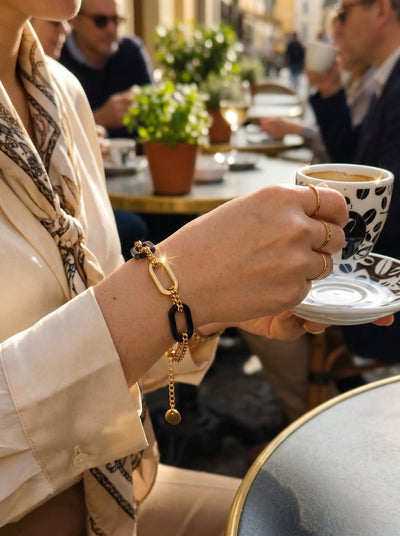
One of the reasons bracelet stacking has become so popular is that it photographs incredibly well. In photos — especially close-ups, coffee shots, hand-on-table poses, and wrist-focused angles — a stacked wrist adds instant visual interest.
What photographs best: varied textures, visible shine, and clear separation between pieces. What photographs poorly: too many identical thin chains that blur into one line.
The Psychology of Wrist Jewelry
Your wrist is one of the most visible parts of your body in daily life. You see it constantly — typing, driving, reaching, gesturing. A well-curated stack gives you a small moment of beauty every time you glance down.
This is part of why bracelet stacking feels so satisfying: it is jewelry you actually experience throughout the day, not just in the mirror each morning.

The No-Fail Stacking Formula
If you want one formula that always works:
- One flat chain (the anchor)
- One textured or charm bracelet (the personality)
- One slim chain (the connector)
- One consistent metal story (or intentional mix)
Three pieces. Three different profiles. One beautiful wrist.
Building Your Stack Over Time
You do not need to buy five bracelets at once. One of the most satisfying ways to build a stack is to add one piece at a time over weeks or months.
Week 1: Start with one flat anchor chain. Wear it solo. Get comfortable with it.
Week 3: Add one charm or textured bracelet. See how the two interact.
Week 6: Add a third piece — something slim — to complete the composition.
This incremental approach ensures every piece earns its spot. And because you are building the stack slowly, you naturally develop a sense of what combinations work and what feels like too much.
Why Bracelet Stacking Is Especially Powerful in 2026
Bracelet stacking has become one of the defining accessories trends of 2026 because it fits the broader fashion mood: personal expression through edited choices rather than flashy excess.
A thoughtful wrist stack says more about your style than a designer logo bag. It shows that you understand proportion, texture, and layering — and that you care about the details people notice up close, not just the ones that register from across the room.
That is why the best stacks never look like they are trying. They look like they happened naturally — because the person wearing them has an eye for what works together.
Conclusion: Stacking Is Composition, Not Accumulation
The difference between a messy wrist and a styled wrist is not the number of bracelets. It is the intention behind each one.
When you vary the width, mix the texture, anchor with one hero piece, and keep the metals cohesive, the stack stops looking like clutter and starts looking like a curator's decision. That is the whole art of bracelet stacking: not more bracelets. Better combinations.

Good stacking is not about having more bracelets. It is about understanding which bracelets belong together.
Start with one anchor. Add one texture. Finish with one detail. That is all it takes to turn a bare wrist into a styled one.
Your wrist deserves the same styling attention as your ears and your neckline.
According to Vogue, bracelets are the most underrated jewelry category—subtle but impactful in every gesture you make.
Harper's Bazaar notes that the bracelet stacking trend continues to evolve with mixed textures and metals.
Who What Wear recommends building a bracelet collection around one anchor piece and layering from there.
Frequently Asked Questions
How many bracelets should I stack?
2-3 for a polished look, 3-5 for more personality. The right number depends on the occasion and how varied the pieces are.
Can I mix gold and silver bracelets?
Yes. Mixed metals are fully mainstream in 2026. Use a 2:1 or 3:1 ratio and let one metal dominate.
What is the best bracelet to start a stack with?
A flat chain bracelet. Herringbone or box chain styles provide a wide, reflective anchor that other pieces can build around.
How do I prevent bracelets from tangling?
Use different chain types and include at least one wide, flat piece. Avoid stacking multiple identical thin chains next to each other.
Should I stack bracelets on the same wrist as my watch?
Most people stack on the opposite wrist. If you do stack with a watch, use slim chains that will not scratch the watch face.